
The 1995 Breakthrough: Robert Silvers and the MIT Media Lab
While mosaic art dates back thousands of years to Sumerian terracotta cones and Byzantine glass tesserae, the digital photomosaic was born in the mid-1990s. In 1995, Robert Silvers, then a student at the MIT Media Lab, developed an automated algorithm that could break a target photograph into a uniform grid and select source photos from a digital catalog that matched the local luminance and color profile.
Silvers trademarked the term Photomosaic and filed US Patent 6,137,498 ("Digital composition of images from smaller images"). His portraits of Abraham Lincoln, Albert Einstein, and the Mona Lisa became global sensations, featured on the cover of Life Magazine and commissioned by international museums.
Spatial Algorithm Evolution: Rigid Grid vs Quadtree Partitioning
How modern engines partition focal high-entropy features (eyes, lips) into micro-tiles (24px) while leaving uniform backgrounds in large cinematic panels (96px).
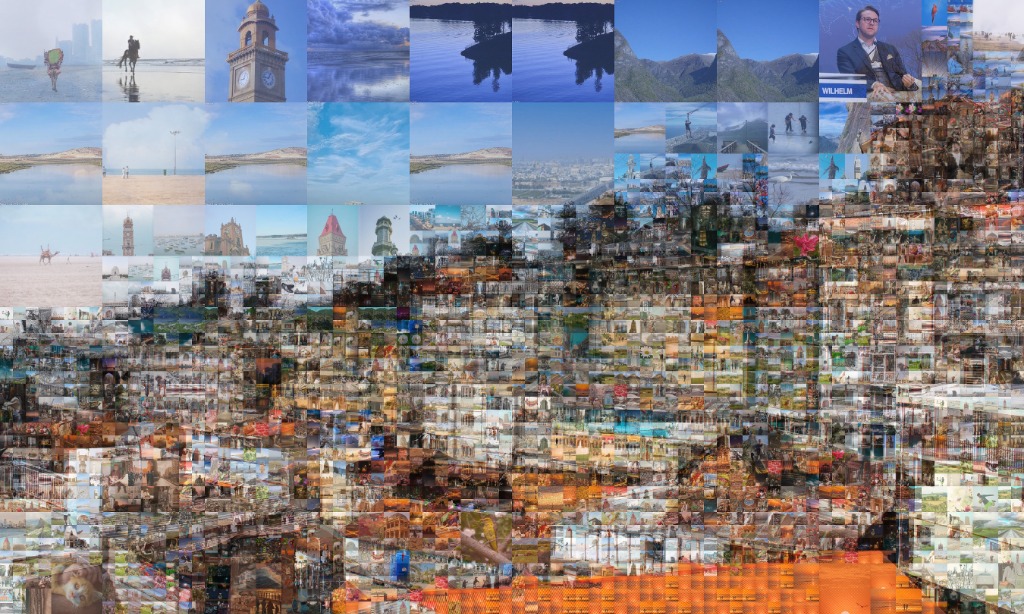
However, in 1995, computational constraints were severe. Finding the best match for 1,000 grid cells across 2,000 photos required comparing millions of pixel arrays. A single high-resolution render tied up an enterprise Silicon Graphics Unix workstation for anywhere from 4 to 12 hours.
The 2000s: Open-Source CPU Crunching on Desktop
As personal computers became common in the early 2000s, software developers sought to bring photomosaics to the desktop. Notable open-source and freeware tools emerged:
- Metapixel (2004): A Linux command-line utility written in C by Mark Probst that introduced anti-repetition distance penalties.
- AndreaMosaic (2003): A popular Windows desktop program by Andrea Denzler that gave creators granular control over tile aspect ratios and borders.
- TurboMosaic (2012): A lightweight desktop application that introduced hexagonal and non-uniform layouts.
Despite their utility, these tools suffered from a shared limitation: they ran on single-threaded CPU loops. Users had to manually download and install heavy desktop software, organize gigabytes of image folders locally, and wait 30 to 90 minutes for progress bars to complete.
The 2010s Compromise: Cloud Servers and the "Fake Tint" Shortcut
With the rise of consumer smartphones and social media, users wanted instant web-based mosaic creation without desktop installs. Early web services stepped in, but encountered a severe server cost hurdle: processing 1,000 high-resolution user photos on cloud servers was expensive and choked server bandwidth.
To cut compute costs, web services took an optical shortcut: translucent color tinting. Rather than finding a photo that genuinely matched the target color, the server placed random photos and overlaid a 40% to 60% colored wash of the master image. From a distance on small phone screens, the portrait looked passable, but printing it revealed muddy, faded squares where individual memories were ruined.
The 2026 Shift: Client-Side WebGL2 Shaders & Real-Time Collaborative Stage
Today, the modern web has eliminated the compromise between speed, privacy, and visual fidelity. By leveraging modern client-side technologies, Photomosaic.work brought high-resolution mosaic creation entirely into the user's browser:
Instead of single-threaded CPU loops, WebGL2 fragment shaders compare thousands of tile histograms in parallel across GPU cores, executing full color matching in under 40 milliseconds.
Because the image matching occurs inside your local browser memory, user photo libraries never upload to remote servers, safeguarding personal family memories.
At corporate galas and luxury weddings, attendees scan a table QR code on their phones with zero app downloads. Photos animate and fly onto ballroom LED screens in under 1.5 seconds, building a living centerpiece live.
To explore the mathematics powering this transition, read our deep dive into CIELAB Delta-E Color Science or review our 2026 Software Benchmark.